

The Geek
The man— if you could call him that— was born to a mother, as we all are– in a scrappy old farmhouse down the muddy backroads of Tennessee. The Mother named the bilious child after the man she thought most likely to’ve sired him; a whore-loving drunkard named Charlie Toufee. And so, Charles Toufee the Second was born one bleak December day. His mother having labored, alone, for three days and two nights, until finally, mercifully, the screams of the wet pink infant echoed shrill and terrible through the stale air of the old farmhouse. His Mother lay prostrate and pallid upon abysmally red bedclothes. Hot blood flowed as if from a spigot from the horrid chasm which burst between his Mother’s legs. The small mattress gorged on the blood like a fat tick. His Mother died clutching her new baby boy to her chest. The infant nursed until the milk ran sour. By a stroke of luck, or perhaps some wicked providence, the infant was found several days later— emaciated but alive— by a traveling bible salesman, who averted his eyes as he cradled the filthy infant and spoke the last rights over the Mother’s bloated corpse.
★★★
Charles Toufee, like his father before him, had fallen in with the drink and the sweet milk of the poppy flower many years ago— how many years he could not remember. As a grown man, some days he thought himself lucky to remember his own name; though he never knew his birthday. After all those loathsome barren years working on the rails, and in the coal mines, and making no more money than could buy him a pint or two of whisky each night for his troubles, Charles Toufee found himself employed by the Sylvester Brothers Travelling Circus, where he cleaned the filth from the menagerie cages and swept up cigarette butts and peanut shells from underneath the bleachers. Charles thought himself lucky that, by way of the caravan, he had a chance to at least see some of the greatest nations the world had ever known. One muggy summer night, Burle Sylvester approached Charles with a proposition the likes of which he found he could not refuse.
At some murky gray point during his years employed as a sideshow attraction with the circus, Charles had transformed from Charlie, to Chucky, to Chuckles, and finally, to Chomps— a name Burle Sylvester, the younger of the brothers and the circus’ prized barker, had bestowed upon him one nauseous evening.
“Chomps” was introduced to the crowd beneath a spattering of spinning red and blue lights, which coalesced to create one single bright white beam of light that left the man, if you could call him that, momentarily blinded. With the strong heaves of two emotionless clowns which perched atop an enormous cage like gargoyles, “Chomps” was released from the iron bars which held him.
He staggered shirtless and drunk into the blinding light, groping at the floor of the small hay covered pit for any movement; any sound. Once the thing called Chomps located the flapping, squawking target, he seized the chicken by the neck and tore off its head with one gnash of his rotting blackened teeth. Chomps likewise devoured the heads of three live chickens and four live rats, which squawked and squealed and twitched— until they didn’t— to the awe and terror of the gawking crowd.
A slow hail of pennies pelted Chomps from above, mixed with hoots and curses from the revolted crowd. Chomps picked the pennies from the hay and grasped them tightly in his dirty fist, fresh hot blood dripping down his unshaven face and neck. Soon he would be in the cage again, and they would bring him his cot once the real God-made freaks began their parade— then he would trade the pennies for moonshine, and drift off twitching into a world that was not so cruel.
★★★
It took fifty strong men to put up the enormous red and white striped tent which housed the Sylvester Brothers Traveling Circus. The canvas was heavy as bricks and patched in many places with anything the carnies could find- torn up overalls, feed sacks, bedsheets, all painted over with large red stripes— and then sealed with a thick coat of paraffin wax to shield the big top’s occupants from the elements. Rain or snow, the show must go on.
★★★
After a time, the freaks had their parade. The dog boy combed his long black fur, the camel girl crawled dreadfully with her buckled knees, and the poor conjoined boys, Romulus and Remus, performed their hula hoop routine to the wonder and revulsion of the packed crowd. Chomps laid on the small cot in his dirty cage. His bottle of moonshine nearly empty and clasped tightly against his chest. He was like a skeleton with dirty white skin stretched over the bones. Suppose there must’ve been guts in there somewhere, lungs, kidneys probably, and even a heart. His gray eyes were sunken back into his skull like a boot in mud. His long blonde hair— tangled and matted as a blackbird’s nest— hung over his forehead in greasy tendrils. His cage was placed backstage, far out of view from the gawking crowds. His cage was placed, not by the dressing tents of the lady acrobats or equestrian men, but beside the menagerie animals— between a chimpanzee named Lucy and a pair of quarrelsome ostriches that squawked and shat and slammed themselves pathetically against the walls of their pen. The thing called Chomps found long ago that it was much easier to remain alone inside his cage— and enjoy what little reprieve the drink offered— for somewhere deep down in his sour guts, he knew that he would be no less trapped on the other side of the bars.
★★★
Just as the thing called Chomps was fading into merciful unconsciousness, he was roused by the booming sound of the circus band, who had cut abruptly into their familiar ragtime rendition of Entry of the Gladiators to begin to play Stars and Stripes Forever. Chomps roused and propped himself up on his elbows, half conscious at first, then acutely alert. In the circus, Stars and Stripes Forever is the universal cue that disaster has struck, and to abandon ship; every man, woman and child for themselves.
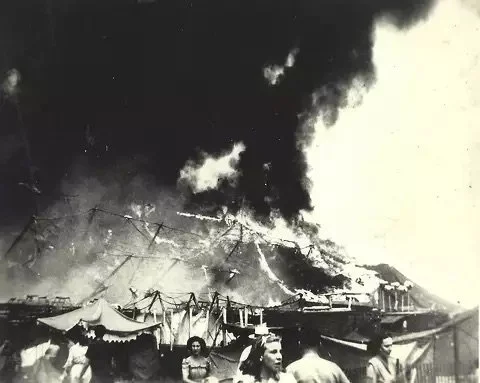
It was a cigarette butt that started the fire. Flicked down to the dry straw covered ground by a man who must’ve been seated way in the back of the bleachers. Most times, when a small fire was started by a discarded cigarette or cigar, one carny or another would simply come and douse the flames with a bucket of water, which were always kept sitting on either side of all the bleachers, in the event of this exact scenario. But this particular cigarette was tossed a little too far back, a little too close to the big paraffin painted canvas tent.
By the time the orange flames rose from the hay ground and began to lick the northernmost wall of the tent, crawling higher and higher and burning hotter all the time, there was nothing anyone could’ve done to stop it. If Poseidon himself had been there in the ring with all the seven seas, not even he could’ve flung the water fast enough. The great red and white big top was consumed by the flames faster than a preacher could pray. There was screaming of all kinds. Women and children jumping from their high seats, spraining ankles, breaking toes. All rushing, pushing, dashing madly toward the timid blue glow of daylight; the only exit. The children’s screaming was the worst. High and shrill and terrible. The screams of children crying for their mothers who couldn’t be found, accompanied in a chorus of horror by the mothers crying out for their children. Bobby, Glenice, Mary, little Frankie, dear God, where were their children? In the hot orange glowing chaos of the fire, thick black smoke billowed from every direction. The lucky ones would asphyxiate. Some would be trampled, and many would burn.
The thing called Chomps unlatched his cage as the screams crescendoed, and the players in the band began to drop out one by one, and then all together. Chomps staggered to his feet as the terrible shrieking filled every crevice of dark hot air. He ran barefoot out into the ring, as the paraffin began to melt and drip in molten bubbling globs onto the swarm of screaming faces.
Though the tent was nauseous with black smoke, Chomps Toufee’s bare feet would not belie the waking nightmare being trampled beneath him. He winced momentarily as the small round glasses of a child broke under his footfall and, to his horror, the little boy’s mangled body convulsed as it was trampled. In every direction, in the hazy light of the fire’s tongue, Chomps saw bodies of women and children. Their flour-sack dresses burnt into their skin, bubbling and black as hot molasses. Somewhere beyond the agonized screams of the dead and dying, the bodies some shrouded in flames, some smoldering, and all looking more like dreadful melted misshapen department store mannequins than once living human beings— Chomps noticed a light. Not the terrible red-orange glow of the putrid fire, but a pure white light, which shone down from an unseen heaven onto a small girl. Dressed in her Sunday best and kneeling, eyes shut tight, though tears streamed down her cheeks, atop the small field of broken mangled bodies, some of which faintly quivered and moaned. The little girl clasped her tiny pink fists to her small chest, seemingly in prayer.
Chomps Toufee sprinted toward the girl, as molten wax and burning streamers of canvas rained down upon his shirtless form like some hellish ticker tape parade. He scooped up the little girl with one arm, and in a quiet act of mercy, held his filthy hand firmly over her eyes. He ran, child in his arms, toward the timid blue glow of daylight which sparkled dimly in the distance. A distance which shrank and shrunk with each stride of his bare feet across the hideous pathway of mutilated bodies. Charles Touffee absconded into the pure, uncontaminated daylight as fire engines wailed and barrelled towards the smoldering ruins of the big-top. He hugged the small girl tight against his emaciated chest and ran like wind across the tremendous field, dashing farther and farther away from where the ashes of the circus tent lay and burned.
In a blur of a thought that felt almost like a dream, Charlie Toufee thought he could almost remember his mother carrying him in her arms when he was a small boy, and for the first time in years, a smile crept across his thin, peeling lips. He was finally, maybe for the first time in his life, doing something good. The feeling of goodness, of kindness and decency, enraptured Charlie’s frail body and in that moment, made the gruesome hideousness of the fire seem no more than a necessary evil toward the divine objective of his own redemption.
Charlie’s sprinting grew to a trot, then a tramp, and then all at once he collapsed to his knees in the lush green field, and set the little girl down in front of him. He removed his hand from her eyes. His beaming grin exposing all his black, rotting teeth, and his sunken gray eyes now bulging from his skull in a fervor of delight. The little girl looked up at him, her white Sunday dress caked with filth and the dried blood of animals, and she began to scream.